

Quick answer
A love spell guarantee is a promise about the result of a service, and under Australian Consumer Law a trader must not make false or misleading claims about what a service will achieve. Master Vijay Ram promises no result: a consultation is $50, a sadhana starts from $250 and is agreed before it is performed, and a guarantee of a result is the signal to walk away.
What is a love spell guarantee, in the law’s terms?
Strip away the candles and the Sanskrit and a love spell sold online is a service: a trader offers to do something for a fee. A love spell guarantee is a representation about the result of that service, a statement that the ex will return, the lover will propose or the marriage will be saved, usually by a stated date. Australian Consumer Law is the national law that governs what traders may say about the services they sell, and it does not stop applying because the service is spiritual.
This article is general information, not legal advice; a community legal centre or your state consumer agency can tell you how the law applies to your own case. What it can do is explain why the guarantee is the red flag rather than the reassurance, what the law says about misleading claims and refunds, and what an honest practitioner’s terms look like by comparison.
Does Australian Consumer Law cover a love spell?
Where a trader in Australia sells a service to a consumer, yes. The law does not ask whether the service works in the way the buyer hopes; it asks whether what the trader said about it was true, and whether the service was provided with due care and skill. A practitioner who believes sincerely in the work is still a trader when money changes hands, and the rules on misleading conduct bind believers and cynics alike.
What the law does not do is make a court of the question whether a mantra works. It judges claims, not faith. That is exactly why a trader who promises a particular outcome has walked onto ground the law can reach, while one who promises nothing but careful work and a fixed fee has not.
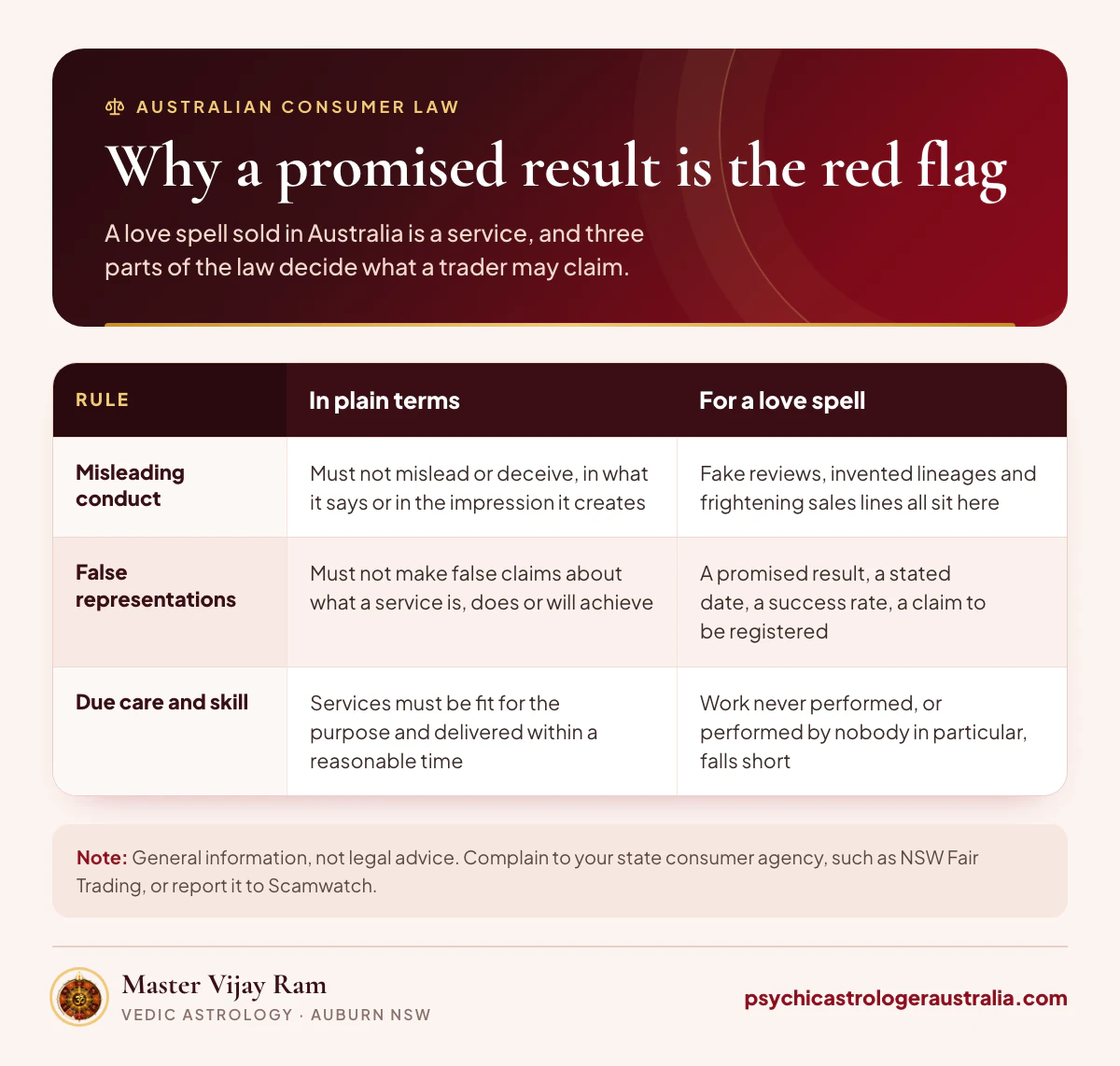
The three rules that matter most
The law is long, but three parts of it do most of the work for a buyer of spiritual services.
| Rule | What it says, in plain terms | What it means for a love spell |
|---|---|---|
| Misleading or deceptive conduct | A business must not mislead or deceive consumers, in what it says or in the impression it creates | Fake reviews, invented lineages and “I can see darkness over him” as a sales line all sit here |
| False or misleading representations | A business must not make false claims about what a service is, does or will achieve | A promised result, a stated date, a “success rate”, a claim to be certified or registered |
| Consumer guarantees for services | Services must be provided with due care and skill, be fit for the purpose the trader was told about, and be delivered within a reasonable time | Work that was never performed, or performed by nobody in particular, falls short regardless of belief |
None of these rules says that an astrologer may not practise, or that a client may not pay for a sadhana. They say that what is claimed must be true and that what is promised must be delivered. A genuine practice has no trouble with either.
Why is a guarantee of a result the red flag?
Because nobody in the tradition can give one. Vashikaran, as the Vedic practice has it, works on the obstruction between two people and never on their will; whether a person then chooses to return is their choice, and no honest practitioner claims to own it. A trader who promises the return is therefore claiming something the practice itself says cannot be claimed, and the law treats a claim the trader cannot support as a false representation.
The promise also does a second job, which is the reason it is made. It removes the pause in which a frightened person would otherwise ask questions. The guide to vashikaran scams shows how the fear script and the promise work together; the law’s word for the combination is misleading conduct, and the plain word is a trap.
The other representations to watch
- A stated timeframe: “he will call within seven days”. A date is a representation, and an invented one.
- A success rate: “ninety per cent of my clients reunite”. Ask for the evidence; there is none.
- A credential: “certified”, “government registered”, “licensed”. No Australian body licenses spell-casters, and the claim is false on its face.
- Tiers: a “basic” spell that fails and a “powerful” one that costs more, which is a price structure, not a practice.
- A complication: “the energy is stronger than I thought; a second puja is needed”. A fee that grows after payment is the pattern regulators warn about most.
- Borrowed reviews and stock photographs, which are misleading conduct whether or not anyone notices.
The guide to love spell costs and timelines sets out the honest answer to each of these, and the guide to astrology scams in Australia covers the same patterns across the wider market.
What does an honest practitioner’s offer look like?
It is short, and it is mostly refusals. A consultation at a fixed fee, stated before the call. A reading of both charts, an honest verdict on whether any work is warranted, and the news, often, that it is not. A sadhana, where it is warranted, at a figure agreed before it is performed and never raised afterwards. No result promised, no date given, no tier, no complication, no culprit named. The vashikaran service page is written in those terms, and so is the love problem solution page.
Seen against the law, every one of those refusals is a representation the practitioner has declined to make, and a representation not made cannot be false. That is why honesty and compliance turn out to be the same thing here.
Can you get a love spell refund?
Sometimes, and the grounds matter. The consumer guarantees do not promise you a result where the service is inherently uncertain, so “it did not work” is, on its own, a weak claim. “The trader promised it would work” is a different claim, because a promised result that was never deliverable is a false representation, and “nothing was actually done” is different again, because a service not provided fails the guarantee of due care and skill.
In practice the first step is to ask the trader in writing, keeping every message. If the payment was by card, your bank can be asked about a chargeback. If the trader is in Australia, your state consumer agency can help; if the trader is overseas, which many are, the law is harder to reach, which is itself a reason to deal only with a practitioner who has a real place of practice and an ABN you can check.
Where do you complain in each state?
Each state and territory has a consumer agency that takes complaints about traders, and the national regulator runs a scam-reporting service as well.
- New South Wales: NSW Fair Trading.
- Victoria: Consumer Affairs Victoria.
- Queensland: the Office of Fair Trading, through the Queensland Government site.
- Western Australia: Consumer Protection WA.
- South Australia: Consumer and Business Services.
- Nationally: the ACCC’s Scamwatch service for reporting scams, and a community legal centre for advice.
Keep the advertisement, the messages, the receipts and the dates. A complaint with a paper trail is a complaint that can be acted on.
How does the escalation usually run?
The pattern that reaches Vijay Ram ji from people who have already paid someone is consistent enough to set out as stages. A low first fee establishes that you will pay. A fear, usually something seen in a photograph or a chart, establishes that you need them. A complication produces the second, larger fee.
A deadline stops you pausing to think, and silence follows when the money stops. Each stage is a representation, and most of them are false; the vashikaran scam is, in the law’s terms, a chain of misleading conduct with a fee at every link.
What are Master Vijay Ram’s terms, plainly?
A consultation is $50, by phone, video or WhatsApp, in English, Hindi or Punjabi. Where both charts show that a sadhana is warranted, a puja or havan performed personally starts from $250, agreed before anything is performed and not raised afterwards. No result is promised, no date is given, and a good number of consultations end at the verdict with no sadhana recommended and nothing further charged.
His only place of practice is Auburn in Sydney; callers everywhere else, including Brisbane and the rest of Queensland, consult remotely on the same terms. Put against the table above, the terms make no representation the law could test, which is the point of them.
Faith, uncertainty and honesty
There is a reason the tradition and the law agree here. Jyotish has always held that a remedy addresses the obstruction and that the outcome belongs to the people involved and to what the tradition calls their karma; a practitioner who promises the outcome has stepped outside the discipline before he has stepped outside the law. The consumer law and astrology question is, in the end, the same question the tradition asks of its own practitioners: did you claim only what you could deliver?
When is this not the answer?
If you have been defrauded, the first calls are to your bank and your state consumer agency, not to another practitioner offering to undo the first one. If the fear planted by a scam has stopped you sleeping, a doctor comes before any reading; faith-based guidance sits beside medical, legal and financial help, never in its place. And if the person you hoped a spell would return has said no, no law and no mantra changes that, and a counsellor is the kinder help.
Five questions before you pay anyone
- What exactly do you promise? The only honest answer is careful work, not a result.
- What is the whole fee, before anything begins, and can it change?
- Where do you practise, and what is your ABN?
- What will you tell me if the charts show the work should not be done?
- Will you put all of that in a message I can keep?
A practitioner who answers all five without hesitation has nothing to fear from the law, and neither do you. The checklist of questions to ask before paying an astrologer extends the list to any reading, and the love spell refund question rarely arises with a practitioner who answered them.
Read next
- Love Spell Specialist in Sydney and Melbourne: What a Consultation InvolvesLove spell specialist in Sydney and Melbourne: what a consultation with Master Vijay Ram involves, which requests he …
- Ex Love Spell vs Vashikaran: What Actually WorksEx love spell or vashikaran: what each word really means, what a Vedic reading can honestly do about an ex, and the p…
- Love Spell Specialist in Brisbane, Perth and Adelaide: How It Works Outside SydneyLove spell specialist for Brisbane, Perth and Adelaide: a $50 reading of both charts by phone or video, sadhana from …
Frequently asked questions
Does Australian Consumer Law apply to love spells and vashikaran?
Where a trader in Australia sells a service to a consumer, yes. The law judges what the trader claimed and whether the service was provided with due care and skill; it does not judge whether a mantra works. A practitioner who believes sincerely in the work is still a trader when money changes hands, and the rules on misleading conduct and false representations apply. This is general information, not legal advice.
Why is a love spell guarantee a red flag?
Because the tradition itself says no practitioner can give one. Vashikaran in the Vedic sense works on the obstruction between two people and never on their will, so whether a person returns is their choice. A trader who promises the return is claiming what the practice says cannot be claimed, and under the law a claim the trader cannot support is a false representation. The promise also removes the pause in which you would ask questions.
Can I get a refund if a love spell did not work?
The grounds matter. A sincere service that did not bring the hoped-for result is a weak claim on its own, because the consumer guarantees do not promise an outcome where the service is inherently uncertain. A result that was promised and could never have been delivered is a false representation, and work that was never performed fails the guarantee of due care and skill. Ask the trader in writing, keep every message, and ask your bank about a chargeback if you paid by card.
Where do I complain about a love spell scam in Australia?
To your state or territory consumer agency: NSW Fair Trading, Consumer Affairs Victoria, the Queensland Office of Fair Trading, Consumer Protection WA or Consumer and Business Services in South Australia, among others. Scams can also be reported to the ACCC’s Scamwatch service, and a community legal centre can advise. Keep the advertisement, the messages, the receipts and the dates, because a complaint with a paper trail can be acted on.
What claims should make me walk away from a practitioner?
A promised result, a stated date, a success rate, a claim to be certified or government registered, a basic tier and a powerful tier, a complication that needs a second payment, and reviews or photographs that look borrowed. Each is a representation, and most are false. An honest offer is mostly refusals: a fixed consultation fee, an honest verdict, a sadhana at a figure agreed first, and no result promised.
What are Master Vijay Ram’s terms?
A consultation is $50, by phone, video or WhatsApp, in English, Hindi or Punjabi. Where both charts show that a sadhana is warranted, it starts from $250, agreed before anything is performed and not raised afterwards. No result is promised and no date is given, and many consultations end at the verdict with no sadhana recommended and nothing further charged. His only place of practice is Auburn in Sydney.
Is an overseas love spell seller covered by Australian law?
The law is much harder to reach when the trader is outside Australia, which many online sellers are. Your bank may still be able to help with a chargeback on a card payment, and Scamwatch still takes the report, but a complaint to a state agency has little purchase on a trader with no Australian presence. That is one reason to deal only with a practitioner who has a real place of practice and an ABN you can check.
Does the tradition itself forbid promising a result?
Yes. Jyotish holds that a remedy addresses the obstruction and that the outcome belongs to the people involved and to what the tradition calls their karma. A practitioner who promises the outcome has stepped outside the discipline before he has stepped outside the law, which is why the tradition and Australian Consumer Law ask the same question of a practitioner: did you claim only what you could deliver?
What should I ask before paying anyone for a love spell?
Five things. What exactly do you promise, where the only honest answer is careful work rather than a result. What is the whole fee before anything begins, and can it change. Where do you practise and what is your ABN. What will you tell me if the charts show the work should not be done. And will you put all of that in a message I can keep. A practitioner who answers all five without hesitation has nothing to fear from the law.
People also ask
Are love spells legal in Australia?
Selling a spiritual service is not against the law. What the law regulates is what the trader claims about it: misleading conduct, false representations about what the service will achieve, and services not provided with due care and skill all breach Australian Consumer Law. A promised result is where most sellers cross the line.
What is a vashikaran scam?
A chain of representations with a fee at every link: a low first payment, a fear seen in a photograph or chart, a complication needing a larger payment, a deadline, and silence once the money stops. In the law’s terms it is misleading conduct; in plain terms it is a trap, and a guarantee of a result is usually its first line.
Can a psychic or astrologer be reported for misleading conduct?
Yes, to the consumer agency in your state or territory, and scams can be reported to Scamwatch. Faith-based services are not exempt from the rules on misleading or deceptive conduct and false representations. Keep the advertisement, messages, receipts and dates, and seek advice from a community legal centre if the sum is significant.
What does an honest astrologer promise?
Careful work and an honest verdict, nothing more. Master Vijay Ram states a $50 consultation fee before the call, reads both charts, says plainly whether a sadhana is warranted, and where it is agrees a figure from $250 before anything is performed. No result is promised, no date is given and no culprit is named.
Can I get my money back from a love spell caster?
Possibly, depending on the grounds. A promised result that could never be delivered, or work that was never performed, gives a stronger claim than a sincere service that did not bring the hoped-for outcome. Ask in writing, keep records, ask your bank about a chargeback, and contact your state consumer agency; overseas traders are much harder to reach.
References & further reading
Serving clients across Australia
Confidential consultations by phone, video & WhatsApp — including: