

Quick answer
Gajakesari yoga is Jupiter in the same sign as the Moon or in the fourth, seventh or tenth sign from it. Roughly a third of all charts have it, so the real questions are whether Jupiter and the Moon are strong enough to deliver it and when their periods run, because it shows mainly in their dashas.
What is Gajakesari yoga?
Gajakesari yoga is a combination in the birth chart that forms when Jupiter stands in a kendra from the Moon: in the Moon's own sign, or in the fourth, seventh or tenth sign counted from it. The name joins two animals, gaja the elephant and kesari the lion, and the tradition reads it as steadiness and dignity joined to courage. It is one of the first yogas people hear about, often from a relative who glanced at an app.
This page goes past the one-line definition: how to check the yoga yourself, why it turns up in so many charts, what makes one strong and another hollow, and when it actually shows in a life. A full kundli reading applies the same checks to your own chart, with the dasha calendar laid beside it.
Why do so many charts have Gajakesari?
Because the arithmetic is generous. Jupiter has to be in one of four signs out of twelve, the Moon's own sign and the three at right angles to it, so roughly a third of all charts carry the yoga on paper. That is not a flaw in the tradition; it is a reason to stop treating the bare presence of the yoga as news.
Searches for gaj kesari yoga usually begin with a report that printed the name, and many people arrive believing they hold something rare. The honest position is that having it is ordinary and having a good one is not. Yogas in a kundli and what they mean explains why a reading names far fewer yogas than a report prints; this page applies that thinking to one yoga in detail.
How do you check for Gajakesari in your own chart?
Find the Moon's sign, then Jupiter's, and count from the Moon with the Moon's own sign as one. If the count lands on one, four, seven or ten, the yoga is there; on any other number it is not. That is the whole test behind gajakesari yoga in kundli software, and it is where the real reading begins.
Use the sidereal positions a Vedic chart gives. A Western chart moves every planet forward by roughly twenty-four degrees, and when only one of the two crosses into the next sign the count changes.
There is a shortcut that makes the check almost instant. The twelve signs fall into three families of four, and the kendras from any sign are always the members of its own family: the movable signs Aries, Cancer, Libra and Capricorn; the fixed signs Taurus, Leo, Scorpio and Aquarius; and the dual signs Gemini, Virgo, Sagittarius and Pisces. If the Moon and Jupiter belong to the same family, the yoga is formed.
| Moon in | Jupiter must be in | Jupiter's dignity in those signs | What that means for the yoga |
|---|---|---|---|
| Aries, Cancer, Libra or Capricorn (movable) | Aries, Cancer, Libra or Capricorn | Exalted in Cancer; debilitated in Capricorn | The widest range: the strongest Gajakesari and the weakest both live in this family |
| Taurus, Leo, Scorpio or Aquarius (fixed) | Taurus, Leo, Scorpio or Aquarius | Neither exalted, debilitated nor in its own sign | Judged on the houses, the Moon's strength and the aspects rather than on Jupiter's sign |
| Gemini, Virgo, Sagittarius or Pisces (dual) | Gemini, Virgo, Sagittarius or Pisces | Own sign in Sagittarius and Pisces | Half of the possible placements put Jupiter at home, a sound base for the yoga |
The table shows why the movable family needs the most care. A Moon in Libra with Jupiter in Capricorn forms the yoga by the count and puts Jupiter in its sign of fall at the same time.
Does it matter which of the four places Jupiter takes?
The texts treat all four as forming the yoga, but a careful reader notices the differences. With Jupiter in the Moon's own sign the two act as one, and feeling and judgement are hard to tell apart. In the seventh from the Moon they face each other, and since in the Parashari scheme every planet aspects the seventh sign from itself, each sends its full glance to the other.
In the fourth and tenth from the Moon there is no direct aspect between them, because Jupiter's aspects fall on the fifth, seventh and ninth signs from it. Jupiter in the fourth from the Moon is traditionally read as support that arrives through home, schooling and inner steadiness; in the tenth, as support that arrives through work and public duty. Neither is weaker by rule, but the yoga shows in different rooms of the life.
What makes a Gajakesari strong?
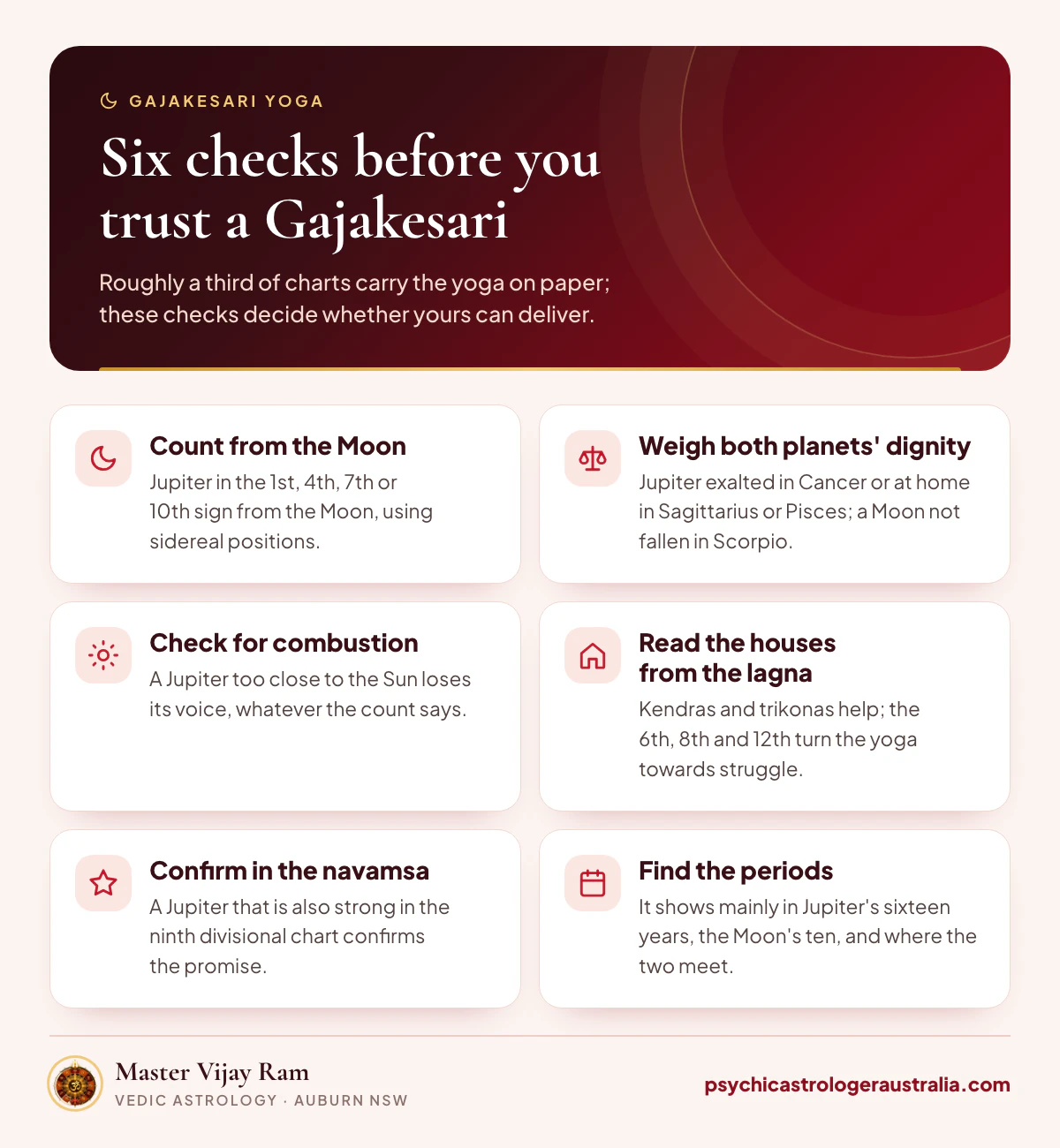
Dignity comes first. Jupiter exalted in Cancer or at home in Sagittarius or Pisces carries the yoga easily, and so does a Moon exalted in Taurus or at home in Cancer. The Moon's light counts too: a Moon born near the full is traditionally reckoned stronger than a thin crescent close to the new Moon.
Houses from the lagna come next. The yoga works best when Jupiter and the Moon sit in kendras or trikonas from the rising sign, and Jupiter's lordship matters: for a Sagittarius or Pisces lagna it is the chart's own lord, while for a Libra lagna it rules the third and sixth, which tints the yoga with effort and competition. Finally the navamsa: a Jupiter that is also strong in the ninth divisional chart confirms the promise.
What weakens or spoils it?
A debilitated Jupiter in Capricorn is the commonest spoiler, unless one of the classical conditions cancels the fall, and how a debilitated planet recovers sets those conditions out. A Moon debilitated in Scorpio weakens the other half. Jupiter too close to the Sun is combust and loses its voice; combust planets explained gives the distances that count.
Placement in the sixth, eighth or twelfth house from the lagna turns the yoga inward or towards struggle. Rahu joined to Jupiter or to the Moon clouds the very judgement the yoga is meant to give, and heavy aspects from Saturn or Mars harden it. None of these erases the combination; each is a weight on the scale, and the reading adds them up.
A worked example: one illustrative chart, checked step by step
Take an illustrative chart, not a real person's. Pisces is rising, the Moon is at 12° Taurus in the third house, and Jupiter is at 2° Scorpio in the ninth. Counting from Taurus, Scorpio is the seventh sign, so the yoga is formed, with Jupiter and the Moon facing each other across the chart.
Now the checks. The Moon is exalted in Taurus; Jupiter sits in a sign of Mars, neither exalted nor fallen, and well clear of the Sun, which in this chart is in Capricorn. For a Pisces lagna Jupiter rules the first and tenth houses and occupies the ninth, a trikona, while the Moon rules the fifth, so the yoga joins the lord of self and work with the lord of children and study.
In the navamsa, the ninefold division of each sign, a planet in the first 3°20′ of a water sign falls in Cancer, so this Jupiter is exalted there. That is the kind of confirmation that separates a working Gajakesari from a printed one.
Timing completes the picture. The Moon at 12° Taurus is two degrees into Rohini, the Moon's own star, so this life begins with about eight and a half years of the Moon's period, followed by Mars and Rahu, and Jupiter's sixteen years then run from about thirty-three and a half to forty-nine and a half. The tradition would expect the yoga to show most plainly in those years, as standing earned through judgement and a name others trust.
And a nominal Gajakesari, for contrast
A second illustrative chart: Gemini rising, the Moon in Libra in the fifth house, and Jupiter in Capricorn in the eighth, a few degrees from the Sun. Capricorn is the fourth sign from Libra, so a report will print the yoga. The reading notices that Jupiter is debilitated, combust and placed in a dusthana, and that for Gemini rising it rules the seventh and tenth, so any strain would show in partnership and work.
Unless a cancellation applies, and in this example none does, that is a nominal Gajakesari: the name of the yoga without the means to deliver it. It is not a curse either. Traditionally it describes counsel that is offered more readily than it is heeded, and good judgement that grows through experience rather than arriving early.
When does Gajakesari actually deliver?
In the periods of the planets that form it. Jupiter's mahadasha lasts sixteen years and the Moon's ten, and the sub-periods where the two meet, Moon–Jupiter inside the Moon's period and Jupiter–Moon inside Jupiter's, last one year and four months each. Transits of Jupiter over the natal Moon or over its own natal place tend to mark the months when the promise comes forward.
When neither period arrives during the working decades, the yoga is not wasted. It tends to show through the household a child grows up in, or as regard that comes with age, which is why the question to ask about any Gajakesari is not only how good it is but when it runs.
Is a Jupiter transit over your Moon the same thing?
No, and the confusion returns every time Jupiter changes sign. A natal yoga is fixed at the moment of birth; a transit is Jupiter's present position laid over that birth chart, and it is judged by its own rules. Under those rules Jupiter's kindest positions from the Moon are traditionally the second, fifth, seventh, ninth and eleventh, so of the four kendras only the seventh counts as a favourable passage.
Over the coming year the movements are these, in Sydney dates: Jupiter enters sidereal Leo on 31 Oct 2026, slips back into Cancer on 25 Jan 2027, returns to Leo on 26 Jun 2027 and moves on to Virgo on 27 Nov 2027. Jupiter's 2027 transit for each Moon sign works through what those months mean, and for your own chart they are read inside a yearly forecast reading.
What does a working Gajakesari look like in a life?
The old verses promise a good name, intelligence, means and the regard of people in authority, in the language of courts and kings. In a modern Australian life it tends to look quieter: the colleague in Perth everyone asks before a hard decision, the community elder trusted with the temple committee's accounts, the teacher whose former students still ring. The common thread is judgement that other people lean on.
The gajakesari yoga effects people hope for, sudden wealth or fame, are not what the yoga describes. It describes a person whose counsel carries weight, and whatever prosperity follows tends to come through that trust rather than in place of it.
Can a puja create or strengthen Gajakesari?
Nothing creates a yoga the chart does not contain, and no rite switches one on. Where Jupiter or the Moon is afflicted in a chart that carries the yoga, the tradition offers prayer: Thursday observances and Jupiter's mantra for Jupiter, Monday observances for the Moon, and conduct that honours teachers and one's mother. Where the chart calls for a formal shanti, a graha shanti puja is performed personally by Master Vijay Ram at his place of practice in Auburn.
That work starts from $250, and the figure is agreed before anything is performed; online puja and havan explains how families join by video. He sells no gemstones, and a yellow sapphire is never suggested from this yoga alone, only after a full chart reading.
Where does Gajakesari's promise stop?
It cannot promise wealth, office or fame, and it cannot override the rest of the chart or the choices a person makes. A strong Gajakesari in a chart with a troubled tenth house still describes a person of sound judgement, not a promised career. This is faith-based guidance within the Vedic tradition, not financial, legal or psychological advice.
How Master Vijay Ram reads Gajakesari in your chart
He needs your date, time and place of birth. He confirms the yoga by the sidereal count, weighs Jupiter and the Moon for dignity, light, combustion and house, checks the navamsa, and then places the Jupiter and Moon periods on the calendar of your life. You learn whether yours is working, nominal or somewhere in between, and when it is due.
A consultation is $50 by phone, video or WhatsApp, in English, Hindi or Punjabi. Readings for Brisbane clients run on Queensland time, which stays the same all year, and anyone who would rather sit across the table can book an appointment in Auburn.
Read next
- Adhi Yoga: Benefics Around the MoonAdhi yoga explained: Jupiter, Venus and Mercury in the 6th, 7th and 8th from the Moon, full and partial forms, why it…
- Kemadruma Yoga: The Lonely Moon and Its CancellationsKemadruma yoga explained calmly: the lonely Moon, which planets count, the cancellations that undo it in most charts,…
- Love Spell Backfire: What Goes Wrong and How to Repair ItA love spell backfire rarely looks dramatic. Learn the three ways it goes wrong, when it tends to surface, and how ho…
Frequently asked questions
How common is Gajakesari yoga?
Common. Jupiter has to occupy one of four signs out of twelve counted from the Moon, so roughly a third of all charts carry it by the basic rule, which is why reports print it so often. The useful question is not whether you have it but how strong it is, judged by Jupiter's and the Moon's dignity, combustion, the houses involved and the navamsa, and when its periods run.
Is Gajakesari yoga formed if Jupiter is in the 7th from the Moon?
Yes. The seventh is one of the four kendras counted from the Moon, alongside the Moon's own sign and the fourth and tenth. In the seventh, Jupiter and the Moon face each other and each aspects the other, which many astrologers regard as an especially direct form of the yoga, provided neither planet is debilitated, combust or placed in a dusthana from the lagna.
Does Gajakesari work if Jupiter is debilitated?
Usually only weakly, unless the debilitation is cancelled. Jupiter falls in Capricorn, and a Moon in Aries, Cancer, Libra or Capricorn with Jupiter there forms the yoga by count while Jupiter is at its weakest. If a classical cancellation applies, such as Saturn or the Moon in a kendra from the lagna, the reading can be quite different, so the chart is checked before anything is said.
Do I need an exact birth time to know if I have Gajakesari?
Less than for most yogas. The yoga is counted from the Moon, and the Moon changes sign only about every two and a half days, so a date with a rough time usually settles it. The time matters for the strength checks, because the houses Jupiter and the Moon occupy and rule depend on the lagna, which changes sign roughly every two hours.
Is Gaj Kesari yoga different from Gajakesari yoga?
No; they are spellings of the same yoga. Gajakesari, Gaj Kesari and Gaja Kesari all join gaja, the elephant, with kesari, the lion. Hindi reports often write it as two words, and some apps add or drop a letter. Whatever the spelling, the condition is the same: Jupiter in the first, fourth, seventh or tenth sign counted from the Moon.
When will my Gajakesari yoga give results?
Mainly in the mahadasha or antardasha of Jupiter or the Moon. Jupiter's period lasts sixteen years and the Moon's ten, and the sub-periods where the two meet last one year and four months each. Jupiter's transits over the natal Moon or its own natal position often mark the stronger months. If those periods fall in childhood or old age, the yoga tends to show indirectly.
Can a gemstone strengthen Gajakesari yoga?
Not as a rule, and never on the strength of this yoga alone. A yellow sapphire is traditionally linked with Jupiter and a pearl with the Moon, but whether either suits you depends on the houses those planets rule for your lagna, which only a full chart reading shows. Master Vijay Ram sells no stones, and buying advice belongs with a gemmologist and Australian Consumer Law.
Is Gajakesari a kind of raj yoga?
Not strictly. A raj yoga joins the lord of a kendra with the lord of a trikona counted from the lagna, while Gajakesari is counted from the Moon and needs no house lordship at all. The two can overlap: when Jupiter and the Moon also rule a kendra and a trikona for your lagna, the same pair forms both, and the reading gives that combination more weight.
Does Jupiter transiting the fourth or tenth from my Moon form Gajakesari?
No. A natal yoga is fixed at birth, and a transit is judged by its own rules. Under those rules Jupiter's kindest positions from the Moon are traditionally the second, fifth, seventh, ninth and eleventh, so a transit through the fourth or tenth is not read as favourable merely because it is a kendra. A yearly forecast reading lays the transit over the natal chart properly.
People also ask
What does Gajakesari yoga mean?
Gaja means elephant and kesari means lion, and the yoga joins the qualities traditionally drawn from both: steadiness and dignity with courage. Astrologically it means Jupiter, the planet of wisdom, sits in a kendra from the Moon, the planet of the mind, so judgement supports feeling. The classical texts promise a good name, intelligence and the regard of people in authority.
Is Gajakesari yoga rare?
No. Roughly a third of charts form it by the basic count, because Jupiter only needs to be in one of four signs measured from the Moon. What is less common is a Gajakesari with Jupiter and the Moon both dignified, clear of the Sun and well placed from the lagna, and that is the version the old texts had in mind.
Which Gajakesari yoga is the strongest?
The tradition gives most weight to one in which Jupiter is exalted in Cancer or at home in Sagittarius or Pisces, the Moon is bright and well placed, neither planet is combust, both sit in kendras or trikonas from the lagna, and Jupiter is strong in the navamsa as well. Even then the yoga shows mainly in Jupiter's and the Moon's periods.
Can Gajakesari yoga be cancelled?
Its value can be largely removed. A debilitated or combust Jupiter, a debilitated Moon in Scorpio, placement in the sixth, eighth or twelfth from the lagna, or Rahu joined to either planet can leave the yoga in name only. Some of these weaknesses can themselves be cancelled, which is why the whole chart is read before the yoga is judged.
What does Jupiter in a kendra from the Moon mean?
It means Jupiter occupies the same sign as the Moon or the fourth, seventh or tenth sign counted from it, the four angular positions. That relationship is the definition of Gajakesari yoga. The quickest check is whether the two planets share a sign family: both in movable signs, both in fixed signs, or both in dual signs.
References & further reading
Serving clients across Australia
Confidential consultations by phone, video & WhatsApp — including: